
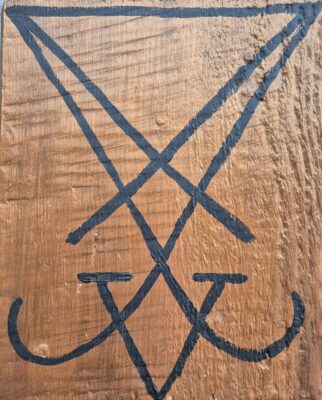
Lucifer’s Blood
”What the tree drank as sap, it inherits as blood. He who strikes at the wrong time wakes indebted.”
Prologue
The roots of a tree do not forget. Least of all when they are severed at the height of their most vigorous growth. This spruce did not fall in the deep sleep of winter, when the sap rests in the roots. No — it was felled in the scorching heat of the summer solstice, while the sun stood at the midpoint of the sky. Those thoughtless, arrogant axe blows granted the falling tree no rest, but instead imprisoned within it the life force that should have been allowed to bleed into the ground. It was left thirsty.
Late on a Friday evening, as I was finishing the dishes after dinner, something hissed sharply against my ear:
”Lucifer’s blood!”
The steel sink stared coldly back at me as I searched for the source of the sound. My husband and the dog, who had already retired for the evening, did not appear to have heard the announcement. I set down the brush. Water was still running in a murmur, but the objects along the rim of the sink looked unfamiliar. I glanced toward the living room: the man lying on the sofa was absorbed in his book, and the dog slept contentedly at his feet. Neither had so much as twitched an ear at the hiss that was still resonating inside my skull.
”Lucifer’s blood!”
It was not a shout. It was more as though ice-cold air had been forced between clenched teeth and driven directly into my ear canal. As I dried my hands on the kitchen towel, I noticed them trembling slightly. The strength seemed to have drained from my body. ”Did you hear that?” I asked, though I knew it was pointless. My husband lifted his gaze, clearly irritated: ”Did you say something?” I shook my head, forced a short laugh, and decided it was best to search the apartment myself. It would not take long in a flat this size. In the dimly lit entrance corridor, the familiar shapes of bookshelves loomed with their dense contents. The home of two bibliophiles resembled a book warehouse more than any twenty-first-century urban apartment. The familiar faint vanilla-like scent of old books and the smell of the recent meal were gone. In their place rose something metallic and sharp — the kind of smell I remembered people describing as the distinct odour of ozone after an electric shock. I stopped in front of the oval mirror and hesitated to look at my own reflection. How was I to know it would be the only one? Lately, on several occasions, I had sensed a presence behind me — both at home and when standing outdoors. Sometimes, while waiting at a bus stop, I felt someone grab the straps of my backpack and the weight on my shoulders would increase. When I turned to look, there was no one there. Once I was playfully brushed at the waist, though I was entirely alone in the shelter. This time, my gaze met a face that looked surprisingly calm despite the exhaustion of the working week. I turned away and hurried to the bedroom. I had completely forgotten the candle I had left burning there. The room held a dense, concentrated silence. The candle had gone out. I assumed my husband might have blown it out before dinner — he is extremely meticulous about such things — but had not bothered to mention it. The corner of the room, far from the generous bed, was dominated by a wooden dresser that had come from my husband’s childhood home. He had taken it with him when he moved to the city to study. After we married, years ago, it was consecrated to my use. Later he gave me an Indian altar, which found its place on top of that same dresser. The extinguished candle stood at its centre. I bent to examine the familiar sight. A reddish liquid had soaked the surface of the altar, and I could see a wet streak of runoff along the painting that leaned against the altar at the back. Carefully inspecting the still-warm candle, I found no gap through which stearin could have escaped onto the base. Besides, what had run was black. I ventured to touch the reddish substance that had appeared on the sacred surface. It was tacky.
”Lucifer’s blood!”
The connection to the inhuman voice I had heard moments before was becoming unmistakable — particularly since the painting on the altar bore Lucifer’s Sigil. I had painted it a few summers ago while sitting in the yard of my husband’s childhood home. I had asked him to bring me a suitable piece of wood from the outbuilding, appropriate for oil painting — exactly the kind of surface commonly used for paintings in the Middle Ages. The streak of runoff on the painting felt most bewildering of all. Had the liquid originated from the seal itself? It would be rather like the sculptures of the Virgin Mary that weep blood, or the blood stones Otto Rahn once found. A sharp gasp escaped my throat. The finger I had pressed into the red residue on the altar burned as though a serpent from paradise had driven its fangs directly into a nerve. I instinctively sucked the poison out, while examining the Sigil I had painted with new eyes. I remembered choosing that particular plank for its rough texture. The grain of the bone-dry spruce had drawn the black paint deep into itself, making the seal look strikingly older than it was. The board itself appeared to have been sawn decades ago — it could easily have been a remnant from the construction of a family home built a century earlier. I noticed the red liquid still rising from within the wood, as though it were bleeding dry.
”Lucifer’s blood!”
The voice croaked now from directly behind me, and I marvelled that I felt no breath on the back of my neck. I spun around so fast that I struck my foot painfully against the dresser. The cry died on my lips as I found the room empty. Faint reading light filtered in from the living room doorway, and I heard my husband turn a page unhurriedly. That ordinary, domestic sound seemed to reach me now from another universe. I turned back toward the altar and found the painting and the candle undisturbed. The shapeless pool on the altar surface was moving. It brought to mind a broken fever thermometer, the mercury of which I had tried to catch as a child on the bathroom floor. This time I let the liquid go, and it flowed like an amorphous creature down onto the top of the dresser below. Before long it was no longer a pool; the liquid was carving its way deeper into the grain of the wood. It made the grain split with faint cracking sounds as the wet inscription etched itself into existence before my eyes.
”Redde quod debes”
”Redde quod debes,” I murmured under my breath. My mind had seized and the sudden, foreign Latin phrase dissolved into a fog. I resolved to look it up later, if I could get hold of my phone. The pain in my finger did not ease but grew colder, and I felt a burning freeze flow all the way to my wrist. The position of one’s limb seemed to make no difference whatsoever. The voice, for its part, reverberated against what I imagine is the location of my spinal cord.
”Redde quod debes!”
It was no longer coming from outside. It was rising from within me. I understood that if I was going to seek help, it had to be now. I moved haltingly toward the bedroom door, steadying myself against the familiar bookshelves. My eye caught the spine of a book I did not recall having seen before. That was hardly remarkable in a home library of thousands of volumes that was constantly growing. With my good hand, I pulled out a leather-bound volume. Ars Sanguinis — The Art of Blood. It had clearly been read many times over the decades, and the book fell open naturally to a particular passage. At this point it was evident that I was meant to find it now. On the open page was an illustration of the very same Sigil I had painted on the altar. Lucifer, it seemed, wished to make something clear to me. The text explained that the grain of certain trees retains memory from centuries past. And that the correct symbol — the Seal of Lucifer — would serve as a key, releasing the alchemical component known as Lucifer’s Blood. Yet that alone is insufficient: the living substance requires a host in order to act. ”Act how?” I whispered half-aloud. To collect an ancient debt, answered the text in the following line. My pulse was elevated, and I decided to take a pause despite the substance pressing ever closer toward my heart. I hoped the pounding drumming against my ribs would settle while I tried to gather my thoughts. As absurd as it sounded, I appeared to have become the host of an alchemical process. Hosts, as a rule, were left as nothing but hollow, drained shells once the parasite had claimed them. What would the collection of a debt truly mean — physically, mentally?
”Redde quod debes!” rang out now against the bone of my forearm.
Sanguis est vehiculum animae — blood is the vehicle of the soul, continued Ars Sanguinis, still open in my hand. Lucifer’s Blood was not simply seeking a human vessel. It was seeking a means of moving through this world — through my veins. This was something altogether different from what is described in the Book of Moses, where demons came to earth having become enamoured of the daughters of men. ”What debt?” I screamed in my mind, though from my lips came only a metallic hiss. Out of the corner of my eye I saw the dark current that had begun in my finger had already reached my elbow. I heard the sofa creak as my husband rose, and the scratch of the old dog’s claws on the bare floor. ”Darling, is everything all right? I thought I heard you talking to yourself.” Footsteps approached the bedroom quickly. Ordinarily they would have brought comfort, but not now. My husband naturally knew about my occult pursuits, but we had never been drawn to this level before. Would the debt attach itself to him as well — or to the dog — from a simple touch? ”Don’t let the dog in here. Close the door carefully behind you,” I said quickly. ”Why is it so cold in here? Have you had the window open?” asked my husband, rubbing his arms, as he made straight for the ventilation window. ”Oh, you’ve already closed it,” he noted when he reached it. ”We thought we’d come to bed.” For some reason he passed over the altar without his customary attention, and he paid no notice to the book I had chosen. ”Yes, go ahead. I’ll come soon,” I continued, opening the door for the old dog waiting on the other side, and I hurried to the sanctuary of the bathroom. Perhaps something otherworldly had concealed the altar’s changes from his eyes, or perhaps he was simply very tired. I set Ars Sanguinis on the edge of the washbasin to read the last words on the open page. ”That which has been taken from the earth at the wrong time must be returned, baptised in blood. The tree does not forget.” The picture began to take shape. My husband’s childhood home, the old dresser, and above all the plank on which I had painted the Seal — none of it had been coincidence. His family had built their home from timber that had been crying out for retribution across generations. I was an instrument who had drawn near to it, given it a voice, and through the Seal provided it with the means to collect its debt. The heavy book slipped from my grip and landed with a soft thud on the bathroom mat. My husband would hardly have heard it, and there was no reason to worry about the movements of a drowsy old dog. I gripped the cool edge of the washbasin with trembling hands. The irises staring back from the mirror were no longer as they had been — they pulsed with the same molten-metal colour as the substance that had continued its advance through my veins.
Sanguis est vehiculum animae.
If blood is the vehicle of the soul, who was now using my body to make the journey? I eased the bathroom door open with care. From the bedroom came the faint creaking of the bed and the dog’s contented sigh. Their ordinary world continued unbroken, though my own was coming apart. My vision blurred heavily from the unknown substance, and it was growing difficult to read. I bent to retrieve the book from the floor and opened it again to the familiar passage. The text continued on the following page. ”That which was cut in light must be joined in darkness. The host must offer a new home — or become the home itself.” Become the home itself. Me? The question ricocheted like a bullet inside my skull, which felt hollow, even though it was plain that the move was already underway. My entire body felt powerless, as though in the hands of torturers. Yet a new, unknown current was advancing, claiming territory point by point. A compact measured in generations — a promissory note the family of my husband had left open. And now I, the daughter-in-law, would become the final signature that settled it. ”I am the home,” I whispered against the cool surface of the mirror. I switched off the fluorescent light. The customary darkness of the evening was gone. The emptiness had become a dense, living mass radiating from within me. The few metres back to the bedroom became nearly impossible as my bones compressed into a heavy heartwood.
Sanguis est vehiculum animae.
My body was no more than a vessel — a transport for something that filled my veins with a hundred-year-old, thirsty sap. Movement was no longer walking, as an ancient shadow slid inexorably across the floor. I smelled the pungent scent of frost-defying earth and iron releasing itself from my pores in rhythm with my still-beating heart into the air of the room. My husband slept. I approached the bed stiffly, every cell demanding rest, demanding to take root. The dog lying at the foot of the bed raised its head in silence. It did not growl, but there was something distant in its gaze. It sensed the strangeness and pressed its head against its master’s familiar legs, as though sheltering in some waystation. The figure that had entered the room was not the same one that had filled its food bowl year after year. I lifted the duvet slowly. The hand felt rigid, stripped of the softness of human skin. Instead of the familiar creak, the mattress yielded under a heavy weight more deeply than it ever had before — as though something had been laid upon it that weighed more than any human being ever could. I lay still. I did not know whether my eyes were open or closed. My darkness had swallowed the room’s air into its black cavity. I was what the tree had once drunk. The tree had become me. By morning light the last human memory would have dissolved, and all that would remain would be a silence smelling of ozone.
Epilogue
In the night, in the dark bedroom, the dog raised its head. It glanced toward the door through which its mistress had entered earlier, but it no longer recognised the familiar scent. In its place was something ancient, deep as wet soil. The smell recalled summer explorations in the earthen-floored shed at its master’s home place. The dog decided not to growl. It lowered itself flat and pressed its jaw firmly against its master’s legs. It felt the duvet shift beside it, and the weight that had settled onto the mattress was too heavy for a human being.
When morning came, the dog leapt down from the bed. Its movements no longer carried the stiffness of an old animal; it moved in silence like a shadow sliding along a gap in the floorboards. It had not cast a glance at the figures lying in the bed. It no longer felt any need to guard or to wait for permission.
The animal passed the altar, on which stood the plank that had now bled its grain clean.
The dog pressed its muzzle against the handle of the front door and the metal yielded. The door clicked open, venting the ozone-scented air from inside. The dog stepped out. It did not linger to sniff the familiar yard, but trotted briskly toward the misty forest edge. Something flashed strangely in its eyes as it left behind a world that did not yet know the spruce had collected its debt.