
Boundary Breakers – An Exhibition Report from the Ateneum
In my heart it was like a burning fire, shut up in my bones. I was weary of holding it in, and I could not,
the prophet Jeremiah expressed his turmoil in the face of a sacred calling. This powerful emotion resonates deeply with artists throughout history. Artistic pursuit is not merely a choice but a calling, often demanding significant personal sacrifices. In Tuonen Portti, we speak of daimonic possession as the driving force behind continuous artistic creation.
With an iconoclastic streak, I approached the exhibition Boundary Breakers at the Ateneum with great anticipation. What did boundary-breaking mean for female artists at the beginning of the 19th century?
”An artistic career was not encouraged,” proclaims the introductory wall text. Nor was mine, though I was born in the 1970s. Such attitudes have long been prevalent, given parents’ understandable concerns for their children’s financial security. Even men were traditionally advised to pursue stable professions like law or military service, reserving painting for leisure.
During this period, the German school of art dominated, with students often traveling to Germany with their families’ support. Even today, studying abroad remains beyond many individuals’ means. This exhibition at the Ateneum, a collaboration with Düsseldorf’s Kunstpalast, delighted me further upon realizing that Düsseldorf is the current home of my portrait of Perttu Häkkinen.
The extensive gallery of portraits initially seems uninspiring, even in our selfie-centric age. Yet, observing these faces closely, I find myself contemplating the hidden thoughts and emotions of the sitters. Ultimately, I easily recognize a young woman’s feelings as she stands at life’s crossroads—emotions once familiar to me. Portrait painting is otherwise unremarkable; many artists repeatedly choose themselves as subjects due to ease of access. Toward the exhibition’s conclusion, visitors can engage in portraiture through photography, an activity visibly enjoyed by groups nearby. The transformative impact of photography on painting fascinates me deeply. As a symbolist painter, I aim to depict what cameras cannot capture. Those interested in traditional portraits will find them permanently displayed at the Sinebrychoff House Museum, whose interiors enhance their aesthetic appeal far better than the clinical environment of the Ateneum.
Children’s portraits presented in the second gallery recall Axel Gallén, who later suggested, while studying in Paris, that Finnish mamselles could best serve their homeland by returning to produce strong sons. This encapsulates contemporary attitudes towards women. Notably, Gallén’s own wife supported his artistic endeavors and bore his children.
Even today, attitudes toward artistic legitimacy remain peculiar. Academically trained artists have greater access to recognition and funding opportunities. Self-taught artists, on the other hand, must frequently demonstrate greater creativity to gain respect, while secular employment significantly reduces the time and energy available for artistic pursuits.
The exhibition vividly illustrates 19th-century dress through three exemplary garments, clearly intended for quiet salon life with books or embroidery. Beyond hoop skirts and corsets, aprons were mandatory attire for women traveling to educational institutions. ”Boundaries” here seem closely linked to modesty—limiting women’s interactions with men, self-presentation, and even their artistic depiction of the male form.
These restrictions eventually loosened, famously symbolized by the bra-burning protests a century later. Women’s artworks and biographies highlight how neither societal expectations nor restrictive fashion stopped their artistic expression. Indeed, adversity often gives rise to profound artistic achievements, as exemplified by Vincent van Gogh’s struggles or Finnish artist Kalervo Palsa, who proclaimed he would ”paint even with excrement” if necessary. True artistry is rarely a choice.
Today, art exhibitions and bookstores increasingly showcase unusual items on the periphery of established art and literature. In this exhibition, the phenomenon is represented by an expansive timeline charting the progression of women’s rights and equality to our present day. One naturally wonders: what are contemporary female artists achieving within these improved societal conditions? Has secular modernity enriched postmodern art, and does suffrage truly influence artistic expression? Given culture’s low governmental priority, would it not be preferable to disregard daily politics and devote oneself fully to art? Abstraction aside, portraits, flowers, and landscapes continue to captivate global audiences. As a symbolist, I envision comfortably working in a hoop skirt within a windowless studio, under a maid’s watchful eye, my mind serving as the portal for emerging ideas. Literature and diverse cultural expressions likewise provide essential artistic inspiration.
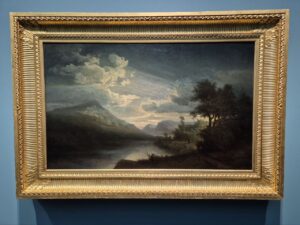
In the 19th century, female artists operated within private studios and schools, excluded from academic painting rooms to avoid distracting male artists—a rationale echoed even today in military settings, where men often find it easier to operate without protecting or competing for women’s attention.
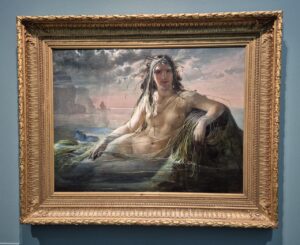
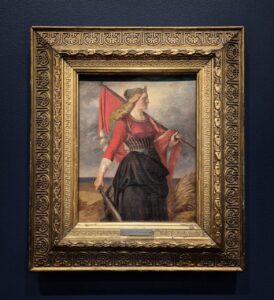 The exhibition highlights two artists particularly captivating to me. Finnish artist Victoria Åberg, whose landscapes found greater acclaim abroad, built a solid career in culturally vibrant countries compared to her homeland under Russian rule.
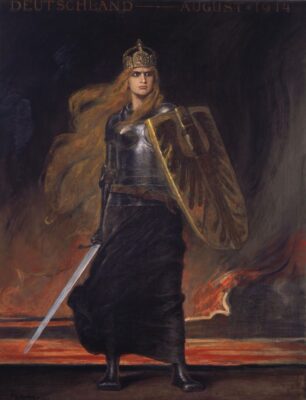
Danish artist Elisabeth Jerichau-Baumann’s masterpieces—Valkyries, Mermaid, and Egyptian Fellah Woman with Her Child—are undeniable highlights. Her work Mother Denmark, reminiscent of Philipp Veit’s Germania, aligns powerfully with Friedrich August von Kaulbach’s 1914 depiction of the same theme. These paintings embody the courage needed to break societal boundaries. Elisabeth notably challenged norms by personally visiting Ottoman harems, realistically portraying their inhabitants contrary to romanticized fantasies prevalent in Orientalist art, exemplified by Ingres’s idealized Turkish Bath. Her realistic portrayals stirred controversy even in liberal Denmark, and these groundbreaking works have only recently become publicly accessible.
Reflecting as both a woman and an occultist, I recognize women’s roles as historically contradictory yet undeniably essential, centered on lineage continuation, often manifesting as protective yet subjugating measures.
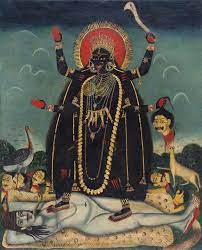
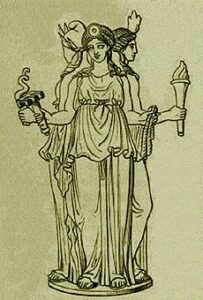 Goddesses have been venerated since humanity’s dawn—from the widely recognized Mary with the Christ Child and Egypt’s Isis and Horus, to myriad other goddesses spanning love, fertility, and darkness. Occult traditions, particularly the Left-Hand Path, honor powerful feminine deities like Kali and Hecate, embodying traditionally masculine attributes similar to Valkyries.
I wholeheartedly encourage engaging with these powerful figures and visiting this compelling exhibition. We have progressed significantly from restrictive mamselles’ chambers, yet perhaps a more neutral title, such as Women of the German School, might have better captured the collection’s essence. Judge for yourselves.
The exhibition is open until August 24, 2025, at Helsinki’s Ateneum, after which it will move to Düsseldorf.