The Mycelium Signal Presents
Furies
An Interview with Väkevä Voima and Bathory Legion
Editor’s Introduction
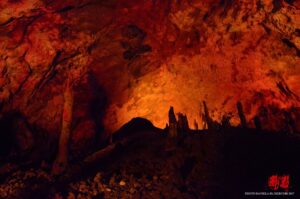
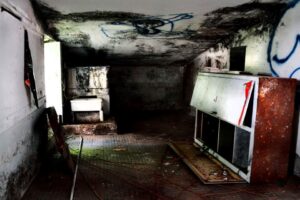
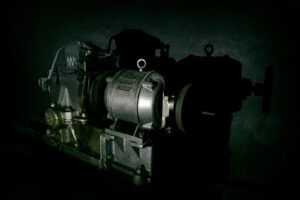
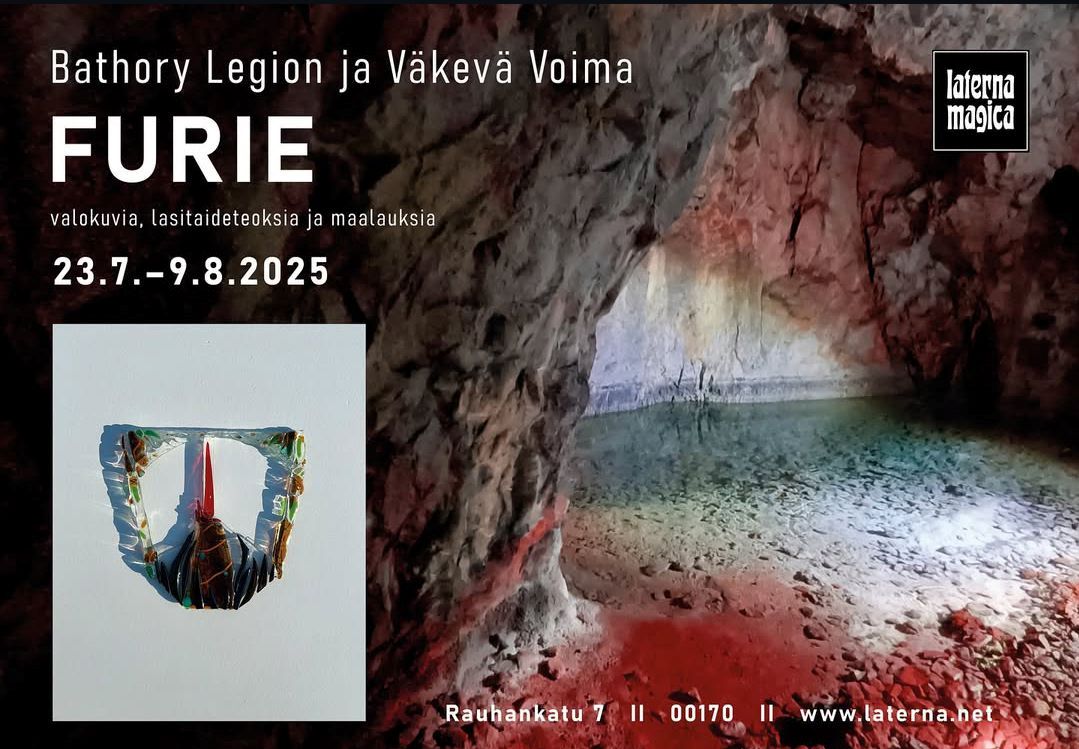
I visited your joint exhibition’s opening at Helsinki’s Laterna Magica on July 22nd 2025. The show featured urban exploration photographs taken beneath the Roman Colosseum by Bathory Legion alongside glass artifacts and paintings by Väkevä Voima.
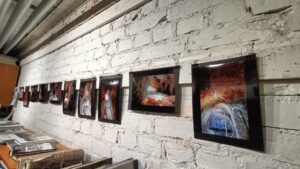
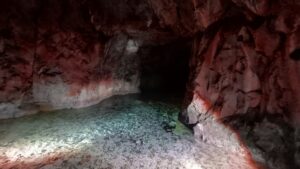
Bathory Legion is a photographer, multimedia artist, composer and gallerist from Rome, Italy whose photographs revealed cavernous spaces textured with mycelium-like red formations, which seemed to evoke the post-apocalyptic world of The Last of Us with its walls covered in fleshy, alien-like mycelial membranes.
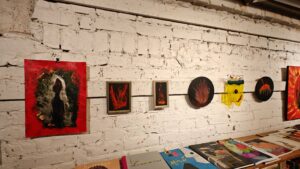
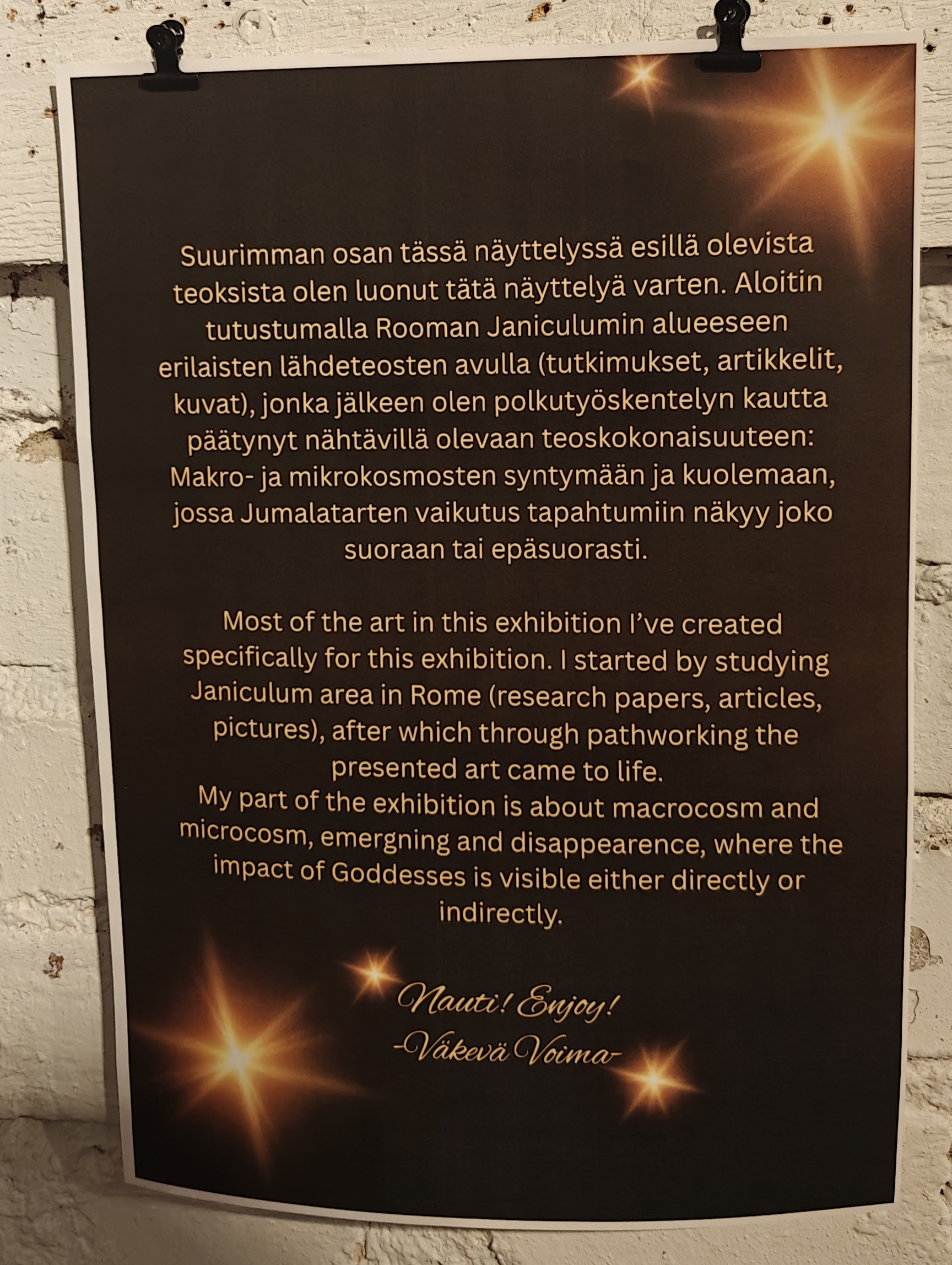
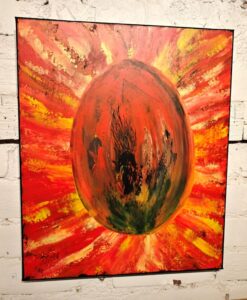
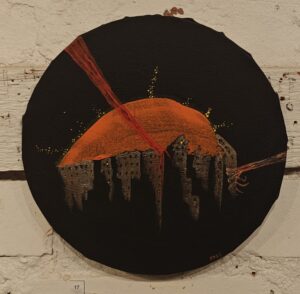
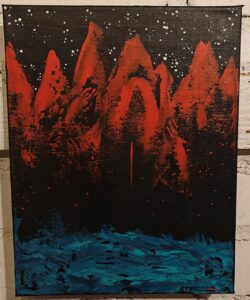
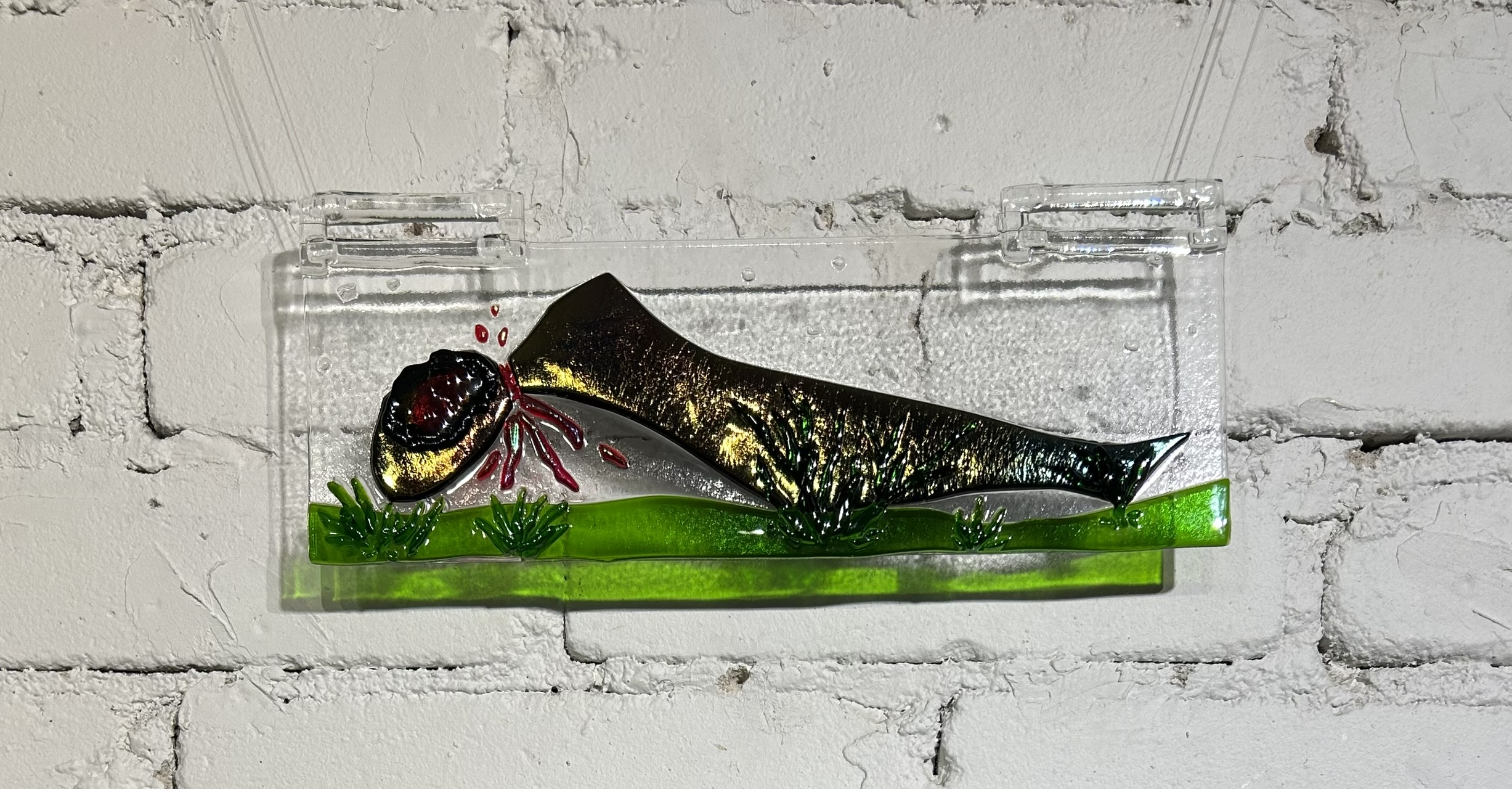
Väkevä Voima is a glass artist and painter from Southern Finland whose paintings and glass art, most created specifically for this occasion, were dominated by red with touches of green and yellow. Upon entering the gallery, I was immediately mesmerized by one particular painting on a black canvas. It appeared to feature three amorphous entities: a human-animal hybrid, a priestess-like figure around a sacred fire, and additional amorphous background entities seemingly reaching toward the sky—all rendered in a fever-dream aesthetic. Their heads seemed to emit numinous white starlight.
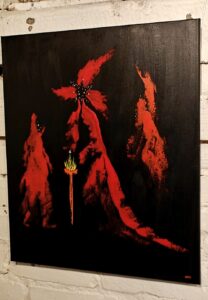
Creation
Väkevä Voima, 2025
What follows is an interview with the artists.
Joint Questions for Väkevä Voima and Bathory Legion
How did you both come together for this joint exhibition at Laterna Magica?
Väkevä Voima
We have known each other for some time already, and during the early spring 2025 we were talking and the subject of art exhibitions came up. I started having exhibitions at the end of last year (2024), and Bathory Legion mentioned they have always been interested in having an art exhibition in Laterna Magica.
I then did a bit of investigation and noticed that applying there to have an exhibition was possible. After that we discussed with Bathory Legion and came to the conclusion that we’d apply for a joint exhibition and everything flowed quite naturally from that point onwards.
Bathory Legion
I had the pleasure of meeting Väkevä Voima through my, now closed, Finnish record label [The Sinister Flame]. She liked my music and some entire releases, and so over the years we started a correspondence on other topics as well. As for me, I had wanted to do an exhibition at Laterna Magica for years, and when the opportunity arose again I told her: ’what do you think, would you like to do this exhibition together?’
How do you perceive the Genius Loci phenomenon in the Finnish/Northern context, as compared to the Roman one?
Bathory Legion
As you well know, the Genius Loci is a concept from Roman antiquity, later extended to the whole world. When I am in Nordic contexts I always tend to try to distinguish between the two. Just as in Rome, in order to enjoy certain energies you have to go to very specific contexts and at certain times, so, I have to say the truth, in Helsinki this time I didn’t feel anything at all, my visit didn’t go as I expected, despite some definitely positive/interesting aspects.
However, I understand what you mean, and it certainly depends a lot on the people. The spirit of the place, the genius loci in fact, is also partly ”activated” by the people present at that moment. It’s a very long speech ahaha…
Väkevä Voima
I think the concept is present in both and is probably a universal one. Since Genius Loci can mean either the spirit of a place or the guardian spirits that inhabit certain places, I’ll comment on both.
Regarding the spirit of the place, Rome, being an ancient city where many of the important places throughout centuries have survived until the modern times, sure is a horn on plenty. I could mention a few places related to our Furie exhibition, where the spirit of the place is strong: Colosseum, the symbol of Rome, and the biggest amphitheater built in ancient times and used for a variety of purposes from educational shows to executions. The catacombs, as burial sites and places of worship, with their underground scent and danger. And, of course the Janiculum Hill which has both spectacular views to Rome but also a long esoteric history of god and goddess worship, and there especially Lucus Furrinae sanctuary ruins, which intrigue me personally. All this and more in a city, and many of the places known around the globe.
In Finland the situation is different. Our spirit of the place, based on my experience, is mostly found in nature. From practical experience, I find it often on hills, such as Pisamalahden linnavuori in Sulkava. Also in ravines inside a deep forest, or places where the ice age has left its marks, and in waters that feel like home to me. Trees are also important, there are places where a tree grows very different from anything surrounding it, which generates a unique spirit of the place.
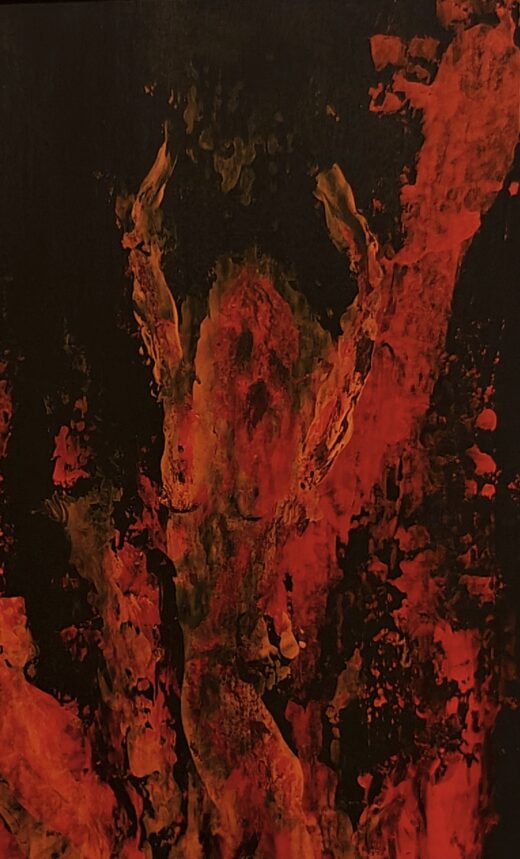
Back then I was already running low on Blood
Väkevä Voima, 2023
I am very fond of certain places where I connect to, and in general I feel that people should remain in the places (or near the places) their family is from, because of the relationship to the land they walk upon. We don’t really have ancient buildings, and I’d assume the oldest buildings in Finland are churches, which are not interesting to me personally, and I think strongest spirits of the place I have felt are in ateliers of Finnish artists from the golden age of Finnish art.
When it comes to the guardian spirits of places or buildings, I think in Rome there is plenty of documentation and evidence of Genius Loci, and the ones in power during different times (earlier) have also kept beliefs alive and have spread practices outside of Rome / Italy. It was common that spirits guarded homes, temples and cities, and their symbol was for example a snake, which represented protection.
In Finland these kinds of things are not so visible, documented, studied, or even known, but we do have a strong pagan tradition where spirits of different kinds have been interacted with and worshipped, again mostly in nature. But, let’s not forget the sauna, and the spirit living there, that is unique in our culture.
What is your relationship to sacred fire, the natural world (including animals and plant life), and entities or daemons that exist beyond consensus reality? How do these elements manifest in your artistic practice, and do you see them as interconnected forces in your creative process? Do you work with these presences directly, or do they emerge spontaneously in your art?
Bathory Legion
In my case it takes place almost exclusively within the ancient Roman undergrounds, catacombs, ancient excavations, to which I have dedicated a long part of my life. I lived four years alone in the mountains in the north of Italy and, in my case, I did not feel the same kind of power and energy.
Do you see yourselves as interpreters of hidden realms as artists?
Bathory Legion
Yes, indeed, and not only as artist, but in every aspects of my life.
Väkevä Voima
Yes, I see both of us like that, and I think for both of us something hidden becomes visible through our art even though our method of expression is different. For someone who is not interested, or not willing to do necessary work, many things fly under the radar and remain hidden, but if there is the right kind of individual with a willingness to commit, I feel then things that have been invisible before become visible, and understanding of the world expands when that connection comes to being.
This means that our art has aspects and atmosphere that can be recognized by individuals that have also visited similar realms, at least based on the feedback I have gotten, it seems to be so.
Do you view yourselves as visionary artists? Where do you draw your inspiration?
Bathory Legion
The inspiration comes from my belonging also as a musician to the black metal of the 90s when it still called itself a movement and all the occult background that goes with it. From the extreme experiences of my life, which I won’t list because now thanks to algorithms you can’t write anything anymore, and from overcoming the ordinances.
Väkevä Voima
My source of inspiration is always darkness, if only one word would be used to define it. I don’t view myself as a visionary artist, but it is mostly since I don’t really view myself as anything specific, I think humans often have the need to label things, but I try to avoid it.
The reason for this is that my art is very much tied to my way of living: solitary nights in nature, experiences flowing through me onto the canvas or to the bottom of my glass kiln. My art can’t exist without darkness. I have already seen how my skills and my art change during time, and I expect both to continue evolving in the future as well.
Can you explain the Roman Furies featured in the exhibition’s title? What invokes fury into your art?
Väkevä Voima
Furies, goddesses of vengeance, pursue and punish people that deserve to be punished, according to mythology. They could be prayed upon, and they could bring justice for wrongs committed. In addition to Furies, goddess Furrina, whose sacred grove Lucus Furrinae located in Janiculum Hill in Rome, was worshipped, and their relation is not 100% confirmed, but could be of similar origin or related to each other.
The Lucus Furrinae grove was first sacred to Furrina, at least until around 500 BCE. After that Syrian cults coexisted with the Roman, and the sanctuary was expanded. When it was abandoned in late fourth or early fifth century CE, it already had a basilica and an altar. Excavations have been carried out at the site and artifacts have been found there. These two things were the main inspiration for me in our exhibition Furie.
Regarding invoking fury: One that has fire burning within most likely has fury too, and it can be a quality used in a destructive or constructive way. I use my fury to get things done, focusing on what is essential. In practice I spend a lot of time making art even though I am not a full-time artist. Hundreds of hours per year on top of everything else. Fury also reminds me not to abandon my ideals. I think, to be able to express fury in art, a person must have fury within themselves.
Bathory Legion
When I thought of the concept for the exhibition, I wanted it to be about a Rome – Helsinki connection. I wanted a complex concept with various ramifications. Therefore I thought about when I visited the Finnish institute in Rome [Institutum Romanum Finlandiae], where the Finnish embassy is also located. This 16th century palace is called ”Villa Lante”.
Also in the area adjacent to the Janiculum Hill in Rome, there is a small and ancient ”sacred forest” [Lucus Furrinae] dedicated to Furrina, a very ancient deity associated with life and death, magic, healing potions, the interrogation of the dead, and groundwater too, among other things. ”Deity” whose anniversary falls on 25 July [Furrinalia], and the dates of our exhibition between 21 July and 9 August.
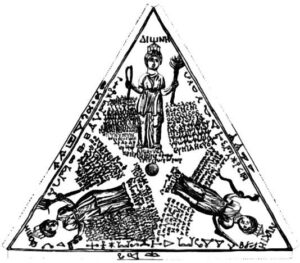
Furrina was finally assimilated to the Furies by assonance of name, connected to the verb ”furere” which alluded to fury. However, her sacred triangle reveals her as Goddess Ctonia, i.e. of the depths of Hades, the ancient Triune Goddess who gives life, nourishment and death.
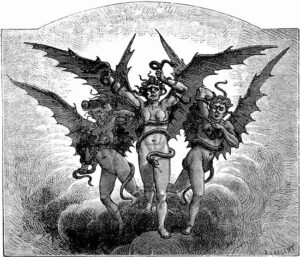
Regarding the ”Furie”, Furies, the iconography is that of winged women running relentlessly after their victims, hunters armed with serpents, punishing Goddesses, Goddesses of curse and revenge, which took place with wars, plagues, discord and instilling remorse.
Combining all these concepts, I decided to photograph, especially for the exhibition, a water source inside a basement in the Colosseum area, whose name I would like to keep secret.