
REVIEW: Akhlys – Melinoë
(Originally written by Konstantin Tuonihovi in late December 2021)
 With this piece, we inaugurate a series of in-depth reviews of music, films, and books; enjoy! Leading off is ”Melinoë”, the third full-length album by Akhlys, an occult black metal band from Colorado established in 2009.
I first delved into black metal in the mid-90s, a subgenre of extreme metal, declined from something truly dangerous and vital to (at worst) a commercial parody of its former self. Without naming names, certain ’winemakers’ and social media figures spring to mind; while remnants of the original diabolical aesthetic linger, the soulfulness has dissipated, replaced by a Kiss-style merchandise enterprise (extending even to dog treats, believe it or not!). Though, I guess… don’t hate the player, hate the game, eh?
A few years back, I was delighted to find that a powerful and vibrant underground current had been persisting, brought to my attention by a friend who is an underground black metal musician. This is the deep end of esoteric, authentically occult black metal, now resurging. After following bands in this genre (like Mephorash, Schammasch, and Ofermod) for some time, December, 2021 Akhlys and their latest album Melinoë kept appearing on my radar, receiving extensive praise from aficionados.
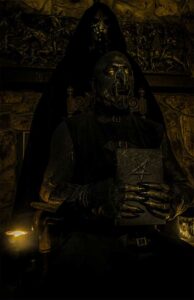 The album’s cover art immediately caught my eye with its exceptional impact, bearing an oddly familiar quality. Closer inspection revealed it to be a work by Denis Forkas Kostromitin, a chthonic-visionary artist highly regarded by our collective, Tuonen Portti, also known for creating Behemoth’s ”The Satanist” album cover. Dominating the front of Melinoë is the severed, ghastly yet malevolently grinning head of an ancient Gorgon, complete with serpentine fangs – a truly malevolent sight.
Naas Alcameth, the band’s founder (also involved with Nightbringer, Aoratos, Bestia Arcana), describes Akhlys as a conduit for a muse emerging from the liminal realms of death and sleep. Their first album, ”Supplication”, was dark ambient music, but by their second, the broadly lauded ”The Dreaming I”, they had transitioned into black metal territory.
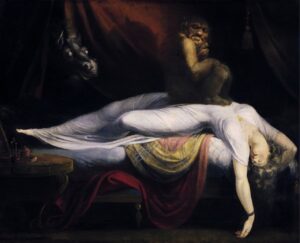
Digging deeper into Naas Alcameth, a figure new to me, I found several of his interviews in the Swedish magazine Bardo Methodology. I usually avoid such interviews as they often dwell on the music and seldom offer deeper insights… However, this discovery was a pleasantly surprising exception. Alcameth revealed himself to be a well-read and experienced occultist. He shared his experiences with sleep paralysis and experiments with henbane as a creator of nightmares, and discussed the concept of Sacred Terror.
Now, it was time to experience Melinoë!
The album starts with a foreboding drone that’s abruptly broken by a chainsaw-like assault of brutal guitars and drums, pausing only briefly before escalating to even more frenetic levels. Initially, the chaos feels almost violent; discerning individual instruments was challenging, even though the production was clearly professional. I sensed this was an album demanding significant engagement to truly unfold. Indeed, this chthonic puzzle began assembling itself piece by piece, requiring focused listening at high volume…
Next, let me introduce you to the tracks ”Succubare” and ”Ephialtes”, analyzed through Portti’s signature ’lyric-visionary’ approach:
A locust swarm’s deafening hiss gradually fills the entire sonic landscape… Whispers of chthonic nymphs emerge… alongside the slowly fading toll of church bells, giving way to an ominous static buzz. It’s like the desperate tuning of a radio, searching but failing to lock onto a coherent signal. Something approaches… its presence palpably angry, reminiscent of a hyena mother ferociously defending her cubs.
An oscillating siren slices from left to right and back, overlaid by a demonic chant that crescendos into an outright scream! The drumming intensifies, dragging the listener into a frenzied, primal dance, like a powerless puppet. Awakening battered and gasping on the cold dungeon floor, you hear the command: ”Breathe in, breathe out!”. You’re pulled back into the maelstrom, desperately seeking escape, but Ephialtes – that nightmarish deceiver – keeps a tight grip on you.
Lying bruised before the very embodiment of Fear, you’re commanded once more, ”Rise, bow, and come forth, wretch!”. You plead for mercy, but none is granted…
ALBUM INFO:
Tracks:
1. Somniloquy 08:52
2. Pnigalion 12:42
3. Succubare 06:25
4. Ephialtes 08:28
5. Incubatio 09:55
Total lenght: 46:22
You can listen to Melinoë album here.
Label: Debemur Morti
Released: 2020
LINKS:
Bardo Methodology magazine’s interviews: Akhlys ja Aoratos
GLOSSARY:
Akhlys (Greek: Ἀχλύς) is a chthonic nymph in ancient Greek mythology. According to Hesiod, she might represent the personification of sorrow. Homer describes Akhlys as a mist that covers or blinds the eyes of mortals at death.
Her Roman equivalent is Caligo, who was claimed to be the mother of Chaos.
Ephialtes of Trachis (Ancient Greek: Ἐφιάλτης) was a traitor who revealed to the Persian forces a path around the Greek positions at the Battle of Thermopylae. This act assisted the Persians in winning the Battle of Thermopylae in 480 BCE. Subsequently, the name Ephialtes has been associated with a lasting stigma and became synonymous with the concept of a nightmare and the archetypal traitor in Greek culture.
Source: Wikipedia